
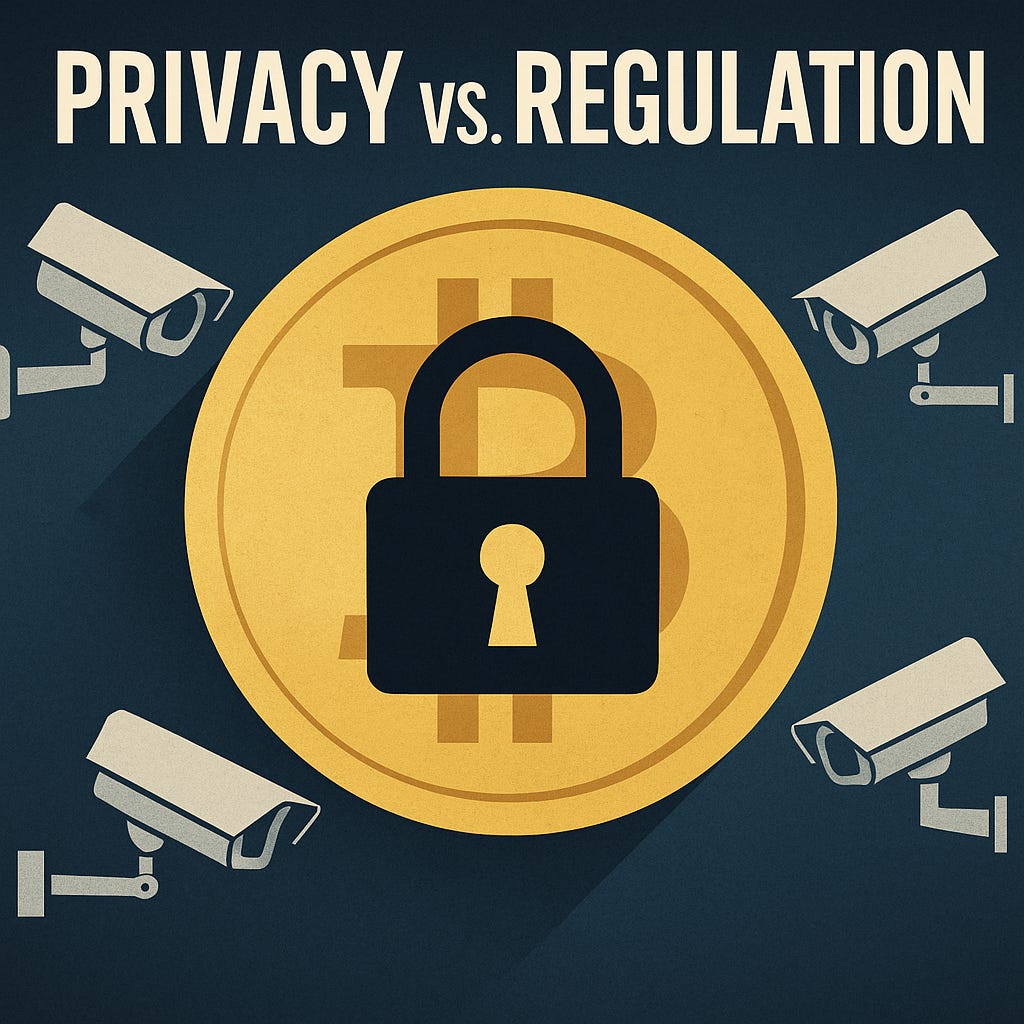
Privacy vs. Regulation: Can Crypto Stay Anonymous in 2025?

Since Bitcoin’s whitepaper in 2008, crypto has promised financial sovereignty, freedom, and privacy. Early adopters saw it as a way to break free from banks, governments, and centralized intermediaries.
Fast forward to 2025, and that original vision is under pressure. Global regulators are rolling out new frameworks, from the UAE’s CARF tax regime to the EU’s MiCA rules and a US–UK Task Force on digital assets. Meanwhile, privacy coins and tools are being delisted, censored, or even criminalized.
The paradox is clear: crypto was born anonymous, but it is growing up regulated.
So, can crypto stay anonymous in 2025 and beyond?
🌍 The Regulatory Wave of 2025
The past year has seen unprecedented regulatory momentum around crypto:
UAE – CARF (Crypto-Asset Reporting Framework):
Signed in 2025, goes live in 2027 with the first automatic tax data exchanges in 2028. Wallet providers, exchanges, and custodians must report transactions, balances, and user identities.EU – MiCA (Markets in Crypto-Assets):
Establishes a unified regulatory regime across the EU. Stablecoin issuers must hold reserves, exchanges must follow strict AML/KYC rules, and licensing is mandatory.US & UK Task Force on Digital Assets:
Joint initiative to harmonize rules across both sides of the Atlantic. Focus: DeFi, stablecoins, and institutional integration.China & Hong Kong:
While Hong Kong is building itself as a crypto hub, the CSRC recently asked brokers to pause RWA tokenization businesses, showing China’s cautious approach.
👉 Takeaway: Regulators want transparency, accountability, and tax compliance. For them, crypto is not an escape hatch, but a system to integrate.
🔒 The Case for Privacy in Crypto
Despite regulation, privacy remains essential for millions of users:
Financial Sovereignty: Privacy protects individuals from government overreach, surveillance, and arbitrary restrictions.
Security: Exposing all on-chain balances can make users targets for hacks and extortion.
Freedom of Speech: NGOs, journalists, and dissidents rely on crypto to operate under oppressive regimes.
Everyday Protection: Just as you wouldn’t publish your bank statements online, people want their crypto usage private.
👉 Privacy in crypto isn’t about hiding crime — it’s about protecting freedom.
🪙 Privacy Coins and Technologies
Privacy in crypto has evolved into multiple layers:
1. Privacy Coins
Monero (XMR): Ring signatures and stealth addresses keep transactions private.
Zcash (ZEC): zk-SNARK technology for optional shielded transactions.
Dash: Features PrivateSend, though less used today.
2. Mixers & Tumblers
Tornado Cash: Popular Ethereum-based mixer shut down by US sanctions.
Countless smaller mixers exist, but face legal scrutiny.
3. Zero-Knowledge Proofs (zkProofs)
zk-SNARKs & zk-STARKs: Prove something is true without revealing underlying data.
Basis for private transactions, zk-Rollups, and selective disclosures.
4. MPC Wallets (Multi-Party Computation)
Splits private key control across multiple parties.
Emerging as a compliance-friendly privacy solution for institutions.
👉 These tools represent the technical backbone of privacy, but face legal and adoption challenges.
⚖️ The Risks and Criticisms of Privacy
Regulators, institutions, and even many investors raise valid concerns:
Money Laundering Narrative: Privacy tools are often linked with dark markets.
Exchange Delistings: Binance, Coinbase, and other exchanges have delisted Monero, Zcash, and Dash under regulatory pressure.
Technical Barriers: Privacy transactions are often slower, more expensive, and harder to audit.
Legal Risk: Using mixers or privacy coins can, in some jurisdictions, bring legal consequences.
👉 For policymakers, privacy = opacity = risk.
🔗 The Middle Ground: Privacy Meets Regulation
The good news: privacy and regulation don’t have to be enemies. A new class of solutions is emerging that balances user protection with regulatory oversight:
Selective Disclosure with zkProofs: Users can prove they are compliant (e.g. KYC’d, not on sanctions list) without revealing full transaction histories.
Regulated Privacy Pools: Protocols like Aave and others explore private transaction rails with compliance modules.
Institutional Privacy Tech: Banks and funds are testing private DeFi with controlled access.
👉 Future vision: Instead of total anonymity vs. total surveillance, crypto may evolve toward programmable privacy — private for users, transparent when required.
👤 What It Means for Users in 2025
If you’re a crypto user today, here’s what you can expect:
Exchanges = No Anonymity: KYC is mandatory. Fully anonymous trading on major platforms is gone.
Self-Custody = Best Privacy: Using hardware wallets and DEXs remains the strongest path to financial sovereignty.
Regulated Privacy Options: Expect new products that let you stay private while remaining compliant.
Dark Privacy = Higher Risk: Using outlawed mixers or coins could expose you to legal trouble.
🔮 The Future of Privacy in Crypto
The future of crypto privacy will not be “all or nothing.” Instead, it’s about balance:
Privacy will adapt, not disappear.
Regulators will demand visibility, but innovation will create middle paths.
Zero-knowledge tech could redefine how compliance works, protecting both users and institutions.
Cultural demand for freedom ensures that privacy will remain a core part of crypto’s DNA.
👉 Final thought: Crypto will never again be fully anonymous, but it will also never be fully transparent. The truth lies in programmable, adaptive privacy.
📌 Key Takeaways
2025 marks the strongest regulatory push in crypto history.
Privacy coins, zkProofs, and MPC wallets are fighting to keep anonymity alive.
Regulators view privacy as a risk, but innovation is creating compliance-friendly solutions.
For users: expect less anonymity on exchanges, more reliance on self-custody, and a rise of regulated privacy tools.
The future of privacy in crypto is adaptation, not extinction.
⚠️ Disclaimer
This article is for educational and informational purposes only. It does not constitute financial, investment, or trading advice. Cryptocurrency investments are highly volatile and risky. Always conduct your own research (DYOR) and consult a licensed financial advisor before making any investment decisions.